
September 23, 2026
Q4 2026 Aircraft Market Outlook: A Canadian Perspective
A new federal tax deduction sharpens the timeline for this year’s busiest season.

On September 15, 2026, Ottawa introduced the Productivity Mega Deduction. It lets qualifying aircraft, new or pre-owned and purchased at arm’s length, be written off in full in the tax year they enter service. That permanently replaces the multi-year capital cost allowance schedule aircraft previously fell under, and it brings Canada in line with the United States, where 100% bonus depreciation for qualifying aircraft was made permanent in 2025. For a market that is already busiest in the final quarter, it gives buyers a new and immediate reason to close and get an aircraft into service before their own taxation year ends. It also arrives on the heels of another recent change: the luxury tax has not applied to aircraft since November 5, 2025.
Canada is part of a highly interconnected North American business-aircraft market, and the new deduction arrives just as pre-owned aviation enters its busiest stretch of the year. AMSTAT, a leading provider of business-aircraft market data, shows December has been the highest-volume resale month worldwide in every year reviewed since 2016. Because the deduction depends on when an aircraft enters service rather than when a deal is signed, the due diligence, financing, importation and registration behind a year-end closing now carry real tax weight alongside their usual operational value. That deadline is each buyer’s own taxation year end, not necessarily December 31. Many Canadian corporations run on a different fiscal year, so it is worth confirming the real cutoff early rather than assuming it falls on the calendar year end.
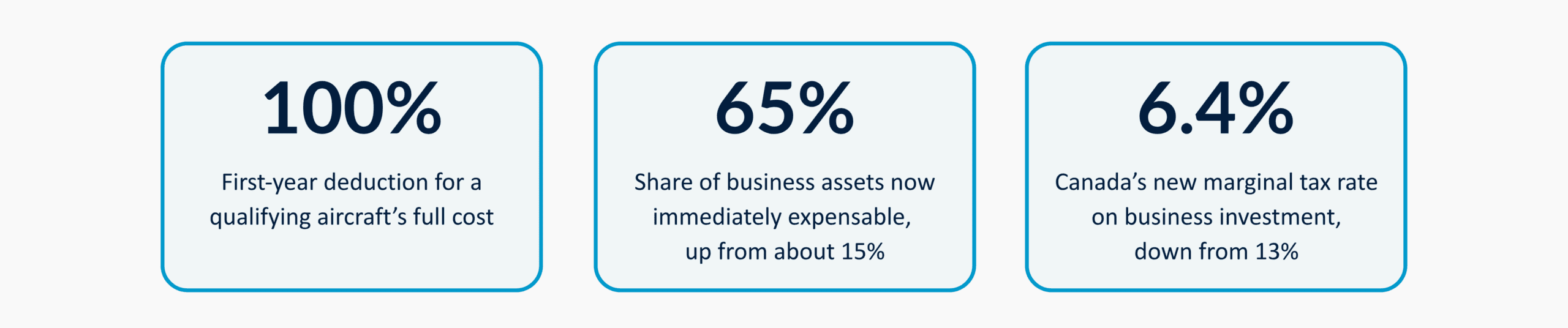
Source: Department of Finance Canada, September 15, 2026.
A decade of transaction activity
To measure this year-end effect, we reviewed monthly AMSTAT resale retail transaction data from January 2016 through December 2025. The chart presents worldwide transaction totals compared to the U.S. involved subset, with December observations highlighted in gold.
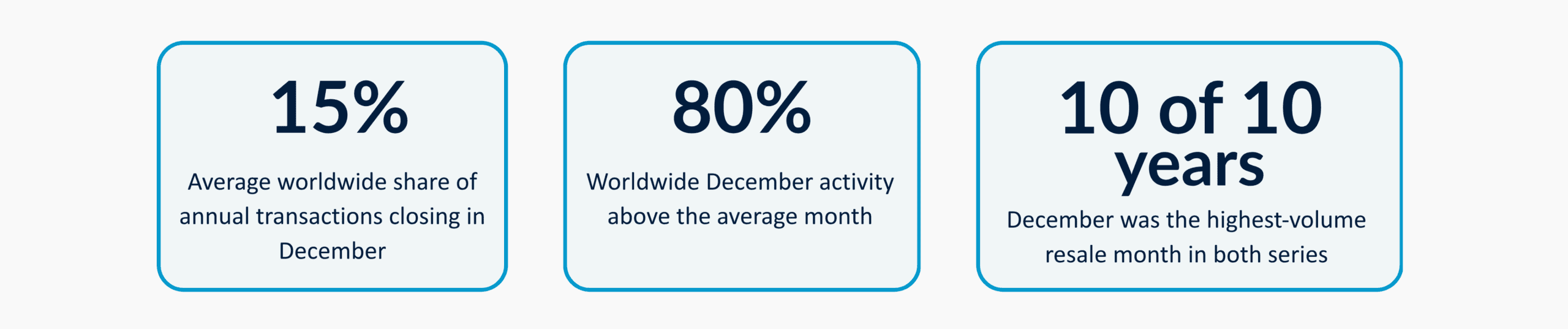
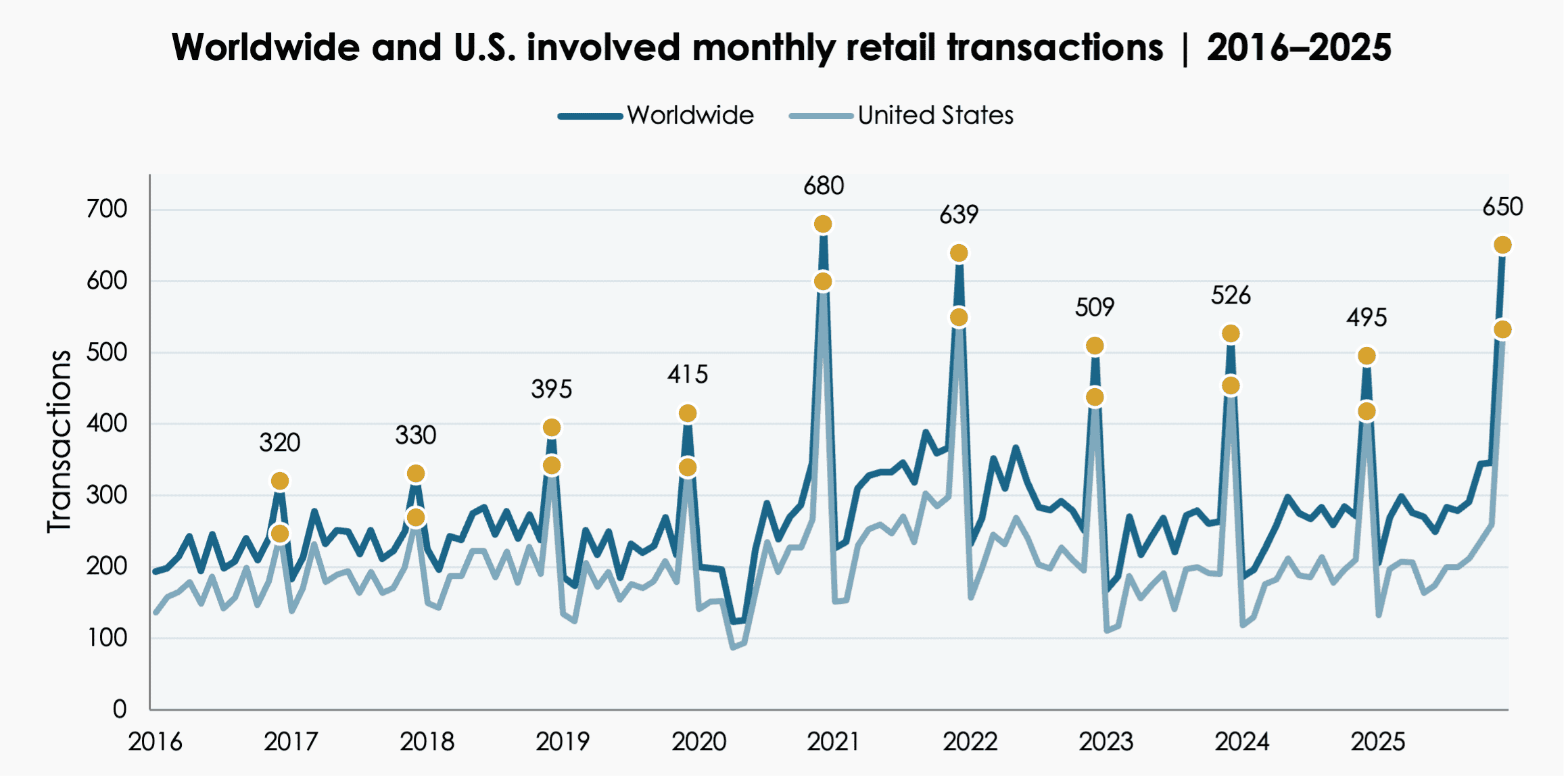
December was the highest-volume month in both series in all 10 years reviewed.
Source: AMSTAT Premier+, Resale Retail Transactions for jets and turboprops, excluding piston aircraft; January 2016 to December 2025. Includes retail-to-retail and dealer-to-retail transactions. The U.S. involved series includes a transaction when either the buyer or seller was recorded in the United States; each transaction was counted once. Analysis by Levaero Aviation.
What the data tells us
AMSTAT data shows a clear and consistent year-end closing pattern. From 2016 through 2025, December was the highest-volume resale month in every year reviewed, both worldwide and among transactions involving the United States. Worldwide, December accounted for an average of 15.0% of annual transactions, roughly 80% above what even distribution would predict. The pattern is even more pronounced in U.S.-involved transactions, where December activity ran approximately 99% above the typical month and accounted for roughly 76% of worldwide volume.
Among transactions involving neither a U.S. buyer nor seller, December accounted for only about 10% of annual activity, evidence that the global spike has long been primarily U.S.-led. That is not a coincidence. The United States has offered some version of full or near-full bonus depreciation for business aircraft in most years since 2002, most recently restored to 100% on a permanent basis in 2025, so U.S. buyers have had a strong, tax-driven reason to close before year-end for a long time. Canada’s own deduction is a significant step toward that same position. For the first time, Canadian buyers have a comparable year-end tax reason to close, and as the incentive takes hold, Canada’s own December pattern may start to look more like the U.S. one, all while still competing for the same cross-border inventory.
Entering Q4 2026
The historical year-end pattern is approaching against an already active and supply-constrained market. According to AMSTAT’s Q2 market report, at the end of June 2026 only 5.8% of the active business-aircraft fleet was available for sale, compared to a 10-year average of 7.2%. Combined pre-owned jet and turboprop transactions increased 11.2% year over year in Q2 and were 14.0% above the 10-year Q2 average.
Together, these figures suggest that buyers and sellers are entering the year-end period with less available inventory, stronger recent transaction momentum, and, for the first time, a federal deduction that directly rewards closing before year-end. This does not mean every aircraft will transact quickly; well-maintained, properly equipped and realistically priced aircraft remain best positioned to attract buyer interest.
Source: Figures are supported by AMSTAT’s Q2 2026 market report.

Canadian buyers can strengthen their position by:
- Working backward from their taxation year-end to the date the aircraft must be “available for use,” not the closing date. In practice the aircraft must be delivered, on the Canadian register and certified to operate. For a foreign-registered aircraft, de-registration, import and Canadian certification come after closing and can add weeks.
- Confirming eligibility and ownership structure with a tax advisor before signing a letter of intent. As drafted, the aircraft must be acquired on or after September 15, 2026, and a pre-owned aircraft qualifies only if neither the buyer nor a non-arm’s-length party has owned it before.
- In the event of a calendar Q4 acquisition, secure a pre-purchase inspection slot immediately upon identifying a target aircraft. Shop slots are the scarcest resource in the fourth quarter. Hold one as soon as a target aircraft is identified, and do not narrow the inspection scope to meet a date.
- Running financing, insurance and operational planning in parallel with the search. Lender approvals and security registrations take weeks. First-time owners also need crew, hangar space, a management arrangement and the right Transport Canada operating approval.

Canadian sellers should prepare by:
- Coming to market now, at a realistic price, if a 2026 closing is the goal. Most deals need six to ten weeks from accepted offer to closing, and longer for export. U.S. buyers have had full expensing since 2025, so the Canadian deduction does not justify a premium.
- Knowing both likely buyers.
- U.S. buyers. Our own data shows U.S.-involved deals are about three-quarters of December volume. Those buyers need the aircraft exported, FAA-registered and in service by December 31. That points to a contract by early November.
- Canadian buyers. A Canadian buyer racing a year-end will value an aircraft already on the Canadian register, because it needs no import or conformity work.
- Clearing title before listing. Canada has no single aircraft title registry. Liens are recorded in provincial personal property registries and on the International Registry. Order searches now and discharge stale registrations from past financings.
- Asking a tax advisor about recapture and replacement timing. Selling a depreciated aircraft can bring past depreciation back into income. A replacement that is acquired and available for use in the same taxation year can offset that. The offset is now far larger than it used to be.

Q4 2026 Outlook
Ten years of transaction data show that the year-end closing pattern is consistent and substantial, particularly in the United States. Canada’s new Productivity Mega Deduction now gives Canadian buyers a comparable tax reason to get an aircraft into service before their own taxation year ends, not necessarily December 31. Combined with inventory that remains below its historical average and transaction momentum that is already elevated, preparing now can preserve choice for buyers and improve positioning for sellers heading into a more competitive year-end market.

Click here to download the report
Questions or looking to discuss what this means for your operations?
Contact us at sales@levaero.com or call +1 905-672-2000