
April 1, 2025
For Canadian aircraft owners and businesses, understanding market trends and projections is essential to making informed and strategic decisions regarding their assets. In Canada, where planning and risk management are highly valued, aircraft residual value plays an especially critical role. Canadians – both individuals and businesses – tend to adopt a conservative approach to asset management, which includes carefully monitoring asset depreciation and planning for long-term investment stability. This awareness allows Canadian owners to maximize their investment by strategically managing the acquisition, sale, and maintenance of their aircraft in order to retain its value. By closely monitoring residual value trends and planning for long-term stability, one can lower their exposure to market volatility and ensure their assets align with their financial and operational goals.
Historical Market Trends
Resale Value
The average annual depreciation rate for business aircraft is around 5-7% in stable market conditions. However, from 2021 to 2024, due to supply constraints and increased demand, many models saw values appreciate considerably. A study by Deloitte, showed that Canadian firms are significantly more risk-adverse than their US counterparts, making strong residual value a top priority. Aircraft models with reliable value retention, such as the Pilatus PC-12 and Gulfstream G650, have consistently high demand in the Canadian market due to their past track record. By investing in aircraft with historically solid resale values, Canadian owners can mitigate financial risk and plan with more confidence.
Demand for Low-Time and Well-Maintained Aircraft
Overall, business aircraft valuations continue to normalize from their peak-pandemic levels, and key value drivers – aircraft age, total time, engine programs – are being weighted more heavily. This trend reinforces the importance of regular maintenance and meticulous record-keeping, especially for those planning to sell within a few years. Canadian owners, both corporate and individual, prioritize well-maintained aircraft, as they align with the value placed on long-term asset health and efficient resale processes.
Effect of Engine Programs
A large majority of buyers prefer aircraft enrolled in an engine program due to the cost predictability and coverage they offer. For risk-averse Canadian owners, being on an engine program can make their aircraft more attractive on the resale market. A study of 19,000 transactions showed that aircraft on engine programs retrieve up to 15% higher resale price, with the largest increase occurring in the midsize jet category. Additionally, aircraft on programs can sell around 40% faster. With the predictability and potential for reduced maintenance costs, Canadian businesses and individuals increasingly consider engine programs as a way to protect value and provide future buyers with added confidence.
Current Market Conditions
Inventory Shortages
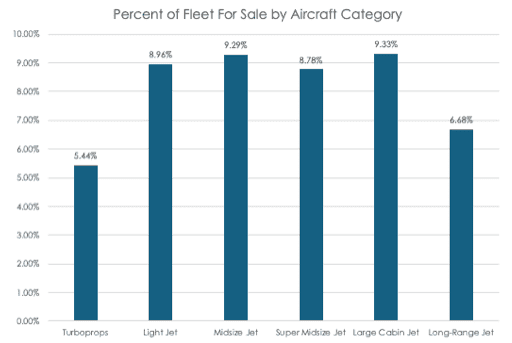
New business jet deliveries remain under pressure as supply and certification challenges persist. From 2014 to 2020, inventory levels fluctuated anywhere from 9-12%. From 2020 to 2021, inventory levels fell from roughly 10% to 6.5%, then further slid to 3.4% in 2022 – a cumulative decline of 6.8% in two years. In 2023, inventory levels began to normalize, climbing slightly below 6% on average, and have since continued this upward trend, hovering around 7.5% in 2024.
As the market stabilizes following the surge in demand throughout the pandemic, aircraft owners considering selling may find the current conditions highly advantageous due to resilient pricing and sustained buyer interest. Although inventory levels are gradually increasing, supply remains limited enough to support strong valuations, providing sellers with an excellent opportunity to maximize returns in the current market climate.
Percent of Fleet For Sale by Aircraft Category
Strong Demand for Business Aviation
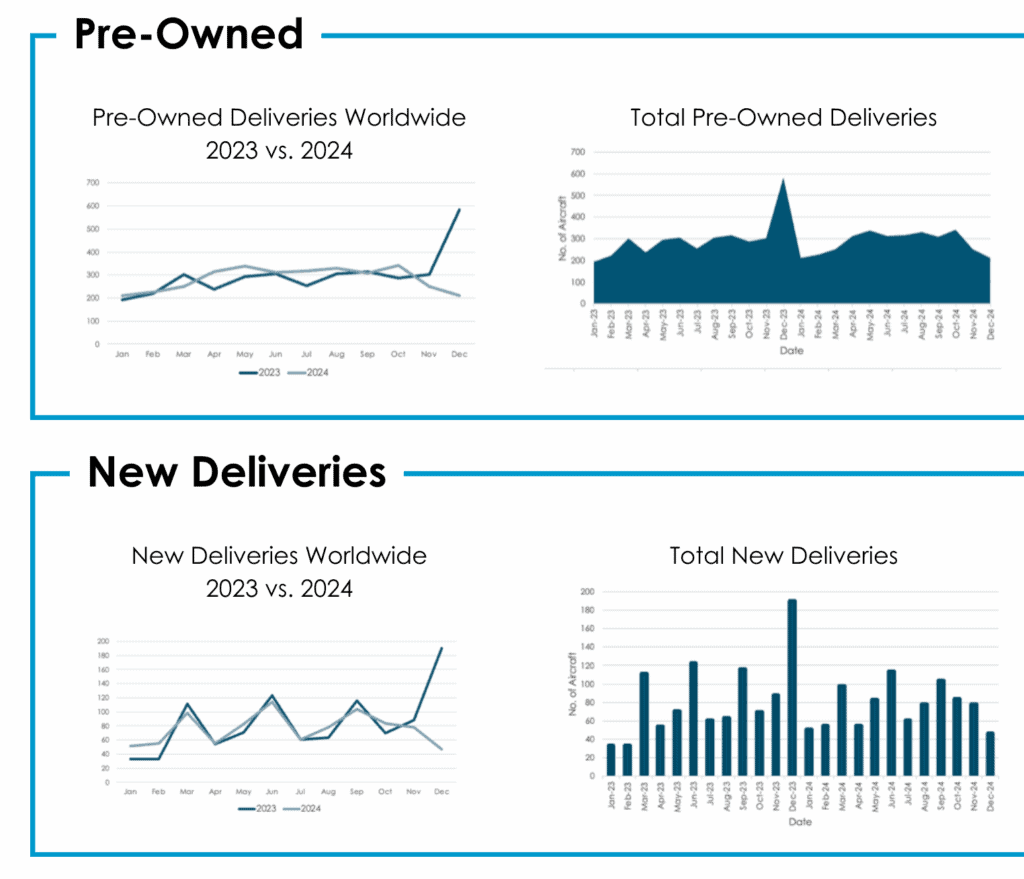
Business jet flight activity has increased considerably since pre-pandemic 2019 levels, experiencing a shift away from corporate flight departments in favour of managed flight operations, charter, and fractional. Business aircraft departures were 14.6% higher in Q3 2024 compared to Q3 2019, demonstrating the increase in the overall user base. From a transaction perspective, the volume of new and pre-owned transactions increased from Q3 2023 to Q3 2024. With economic uncertainty and a slowdown in activity in Q3, as a result of buyers waiting for valuations to come down and sellers wanting to secure post-pandemic gains, transactions have eased, yet the market remains active.
The Global Economy
The global economy significantly influences the business aircraft market, affecting ownership trends, operating costs, and buyer behaviour. In 2024, interest rate movements, supply chain and certification disruptions, and geopolitical tensions are shaping the market environment. For Canadian owners, these challenges highlight the importance of conservative financial planning and asset management.
Interest Rate and Financing
Higher borrowing costs, influenced by central bank policies, are leading some buyers to delay purchases or prioritize aircraft with strong residual values. However, interest rates in Canada are coming down, currently 3.25%, which could encourage more buyers to re-enter the market, potentially boosting demand and stabilizing residual values. For sellers, this shift highlights the continued importance of competitive pricing strategies to capitalize on the improving market sentiment while buyers adjust to the changing financial landscape.
Currency Exchange Rates
The continuous weakening of the Canadian dollar relative to the U.S. dollar continues to play a critical role in cross-border transactions, negatively impacting the cost of acquiring or selling aircraft in international markets. Conversely, Canadian businesses or individuals earning revenue in U.S. dollars are in a stronger position, as their purchasing power has increased. This dynamic has made them more eager to buy, particularly in international markets, where they can take advantage of favorable exchange rates to secure high-value assets at relatively lower costs.
Economic Uncertainty
Concerns over global economic stability, fluctuating markets, and rising costs have led many buyers to take a more strategic approach to aircraft acquisitions. Rather than delaying purchases, Canadian owners are increasingly focused on selecting aircraft that offer long-term value, efficiency, and strong resale potential. This trend is driving interest in new aircraft, which provide the latest advancements in fuel efficiency, technology, and operational cost savings – factors that enhance financial predictability and overall investment security. Additionally, buyers who prioritize reliability and factory-backed support see new aircraft as a compelling choice, ensuring they maximize uptime and operational efficiency in any market condition. Some may shift their attention toward pre-owned aircraft of the same, or look to retain their existing aircraft.
Future Projections
Sustained High Demand
A recent forecast from Honeywell predicts that up to 8,500 new business jets will be delivered over the next decade, with strong demand from North America, Europe, and Asia. This demand could help maintain high resale values in the coming years. For Canadian owners who may eventually sell, current market dynamics appear promising, while those considering upgrades should plan for limited availability.
Value Stability for Certain Aircraft Types
Ultra-long-range jets and turboprops retain their value particularly well, with depreciation rates approximately 2-3% lower than the average in other categories. For Canadian owners of models like the Bombardier Global 7500 or Pilatus PC-12, value retention remains a significant advantage. Given the conservative approach of Canadian businesses and individuals, investing in aircraft with stable values helps ensure both financial prudence and future marketability.
Environmental Regulations and Impact on Aircraft Value
With emerging environmental standards, current fleets could face impacts from sustainability-driven regulations by 2030. This may lead Canadian businesses, which often prioritize long-term planning and corporate responsibility, to consider the environmental compliance of aircraft more closely in their risk management strategies. Newer, more efficient models are expected to align better with these regulatory shifts, potentially supporting stronger value retention. As these trends evolve, such aircraft could play a role in mitigating risks associated with value erosion due to future environmental policies.

Strategies for Aircraft Owners
Consideration of Upgrades
Studies show that equipment upgrades can increase resale value by low double-digits depending on the aircraft type and modifications. For both personal and corporate aircraft owners, upgrading avionics, interiors, or other features can improve resale value and overall aircraft appeal. For those not looking to sell, upgrades can enhance the flying experience and operational efficiency, making ownership more practical and enjoyable.
Exploring Engine and Maintenance Programs
Aircraft on engine programs typically retain more of their value upon resale than those that are not enrolled. Engine programs offer cost predictability and are increasingly attractive to buyers who prioritize asset protection. Enrolling in a program not only helps control maintenance expenses but also boosts the appeal of the aircraft for future resale, catering to Canada’s more cautious and strategic approach to asset management.
Proactive Market Monitoring
Aircraft values can fluctuate up to high single-digits within a single quarter due to market conditions. By regularly monitoring their aircraft’s value and market trends, Canadian owners can make informed decisions about the timing of a sale or upgrade. Working with an IADA-accredited aircraft broker provides insights that align with the conservative and strategic planning often preferred by Canadian businesses and individuals.

For today’s Canadian aircraft owners and businesses, the market presents both opportunities and challenges. By staying informed about historical trends, understanding current conditions, and planning for future projections, Canadian owners can make data-driven decisions that protect and grow the value of their assets. Whether considering a sale, an upgrade, or fleet diversification, having the right strategy in place ensures that aircraft investments continue to yield benefits for years to come.